Not an uncommon story: Woman gives birth alone with help of 911

This story is one that gets a lot of media attention, such that it seems to happen all the time. There are variations on the theme: woman gives birth in taxi cab, woman gives birth on side of freeway, woman gives birth at home with husband, in the doorway of the hospital ER, etc.

Moral of all these stories? Birth is unpredictable, can happen at anytime and no matter how hard we try, WE CAN’T CONTROL IT.

Second moral of these stories? Sometimes you don’t need a doctor. Or a midwife. Or a doula. All of these stories show women giving birth alone, or only with a 911 operator or a partner coaching her along. And in most cases, she and the baby turn out fine. I want to see them teaching this in OB/GYN programs.

My favorite quote from this story:

Rosales’ husband, Allen, was attending a meeting at Kendall College when his wife went into labor about 7 p.m., three weeks before she was due.She sent her 2-year-old son, A.J., downstairs to get her cell phone so that she could call her nurse-midwife. A.J. first came back with money, so Rosales sent him back to get the phone. A.J. went back downstairs, played with his T-Rex for a bit and then returned with the cell phone after Rosales called for him.

Happy Friday everyone!
Post-partum plastic surgeries

This is timely, considering that I just posted about a site that is all about admiring post-pregnancy bodies, instead of surgically altering them.

The NYTimes has an article about “Mom Jobs” or post-pregnancy plastic surgery makeovers, with the goal of giving women their bodies “back.” What is our obsession with trying to avoid and evade change?

Aimed at mothers, it usually involves a trifecta: a breast lift with or without breast implants, a tummy tuck and some liposuction. The procedures are intended to hoist slackened skin as well as reduce stretch marks and pregnancy fat.

“The severe physical trauma of pregnancy, childbirth and breast-feeding can have profound negative effects that cause women to lose their hourglass figures,” he said. His practice, Marina Plastic Surgery Associates, maintains a Web site, amommymakeover.com, which describes the surgeries required to overhaul a postpregnancy body.

I don’t know about you all, but I’ve never had what could be described as an “hourglass” figure, and don’t particularly strive for one.

The article goes on to bring up the reasons why this trend could be problematic, including costs, stigmatizing mother’s bodies, and the risks associated with unnecessary surgeries.

Feministe brings up a good point though, that this is really only going to be an issue for the richest populations, since most women can’t afford a surgery that costs between $10,000 and $30,000 dollars. But I do think the statistics about the rise in plastic surgery are frightening, as well as the link to cesarean sections. Other countries with high plastic surgery cultures, like Brasil, also have extremely high c-section rates (almost 90% in some areas) and I don’t think that is a coincidence.

Thanks to Adam and Feministing for the link.

In case you needed another reason not to want a c-section

This one is scary, and unfortunately not from an episode of ER or Grey’s Anatomy.

A Florida woman is being awarded over 2 million dollars in damages after a doctor left a one foot by one foot surgical sponge in her uterus after a c-section. According to the woman, it was severe pain in the days following her c-section that brought her back to the hospital.

“I couldn’t walk,” she said. “I had to double over because the pain was horrendous.” When antibiotics did nothing to alleviate what doctors said was an infection, Dr. Joseph Becerra took an X-ray. The radiologist noticed a foreign object lodged in the 37-year-old’s abdomen, but it took days before Becerra removed the 1-foot by 1-foot surgical sponge that eventually damaged her uterus.

Here’s the even scarier part:

According to Florida’s Agency for Healthcare Administration, there were 88 surgeries in 2005 in hospitals statewide to remove objects left in patients from a previous operation.

And that’s just in Florida.

Hysterectomy Hysteria

Ok, so that title is a little bit much. I have trouble avoiding some good alliteration sometimes.

I just read an interesting article in the Washington Post about one woman’s experience with hysterectomy. Another issue that is not really on the radar of midwives and doulas, let alone reproductive rights groups.

Stephanie Weiss discusses how she had to do a lot of badgering, as well as her own research to finally find a doctor who was willing to do a minimally invasive laparoscopic hysterectomy. And she didn’t get her entire system removed either, just the uterus and her melon sized fibroid (non-cancerous growth).

A surgeon removed my uterus — then the size of a 20-week pregnancy — through a quarter-inch hole near my belly button, leaving my ovaries and cervix intact.

From her perspective, the procedure she received was nothing compared to how most women still get their hysterectomies, what she calls “her mother’s hysterectomy,” through a large horizontal incision in the belly.

Old myths — including the one about minimally invasive surgery being excessively risky — die hard. Research shows that, in experienced hands, the risk of minimally invasive procedures is the same as or less than the risk of abdominal hysterectomy, Streicher said. But George says that 80 percent of the hysterectomies now done abdominally could be done laparoscopically.

Another instance in reproductive health care where women may not be getting the information they need to make the best options.

Admiring post-pregnancy bodies

square.jpg

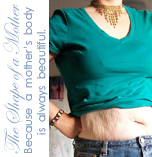
I discovered this interesting site, The Shape of a Mother, which displays women’s pictures of themselves post-baby. Very cool–let’s help women not be ashamed of their pretty much unavoidable stretch marks, being a mother is a beautiful thing and so are their bodies, loose skin and all.

Thanks to Red Pomegranate for the link.

UK group promotes water birth

The UK group, National Institute for Health and Clinical Excellence, released guidelines calling for access to water during labor for low-risk women giving birth at between 37 and 42 weeks.

“There is a perception that water is just nice,” said Dr Julia Sanders, a consultant midwife and member of the group which drew up the guidance. “But it is the most effective form of pain relief barring an epidural in labour. I would like to see more women using water and fewer women using the types of pain relief that are less effective.”

If you have seen any of the many videos about water birth, or experienced first hand the soothing and relaxing capabilities of water during labor you’ll be happy to hear that this group in the UK is promoting it’s use.

We use water to cure all sorts of ailments, warm baths to relax and calm, to sooth cramps or sore muscles. Continuous external fetal monitoring is one of the biggest obstacles to incorporating water into birth practices in hospitals, as well as doctor’s unwillingness to accomodate the mother in a tub or pool.

Anyone have any great stories about using water during labor that they want to share?

Via The Guardian.