Reviews and Excerpts of the Radical Doula Guide

Each August I try to take at least two weeks off from work, which mostly translates as not checking my email. It’s a necessary ritual for my sanity, and for my brain to re-calibrate to life away from inboxes. This year’s vacation also coincided with a move from Brooklyn, NY, where I’ve been living for the past two years, back to Washington, DC where I used to live.

While I was away, a lovely number of you (about 40) ordered copies of the Radical Doula Guide. Thank you! I put those copies in the mail today, so apologies for the delay.

If you haven’t gotten your copy yet, there is still time. I’ve already sold about half of the guides I printed, so don’t wait too long!

You can order your copy here.

Anna J. Cook, a long-time reader and fellow feminist blogger wrote a lovely review of the guide. It’s thoughtful and comprehensive and you should read the whole thing. But here is a quick taste:

Miriam’s 52-page “political primer” discusses the political nature of what she terms “full spectrum pregnancy and childbirth support” — a concept that covers not only childbirth and postpartum doula work, but also abortion and miscarriage doula care, a relatively new service some trained doulas are offering. There are books and training workshops available for learning doula techniques, and The Radical Doula Guide doesn’t seek to replicate those resources. Instead, Miriam offers some reflections on how doula work intersects with political systems: “a starting point to understanding the social justice issues that interface with doula and birth activism” (4).

In four brief sections, Miriam acts as a tour guide through different aspects of full-spectrum doula care and brief analyses of three broad categories of intersection between pregnancy and politics: “bodies” (race, gender, sexual orientation, size, age, and HIV/AIDS), “systems” (immigration and incarceration), and “power” (class and intimate violence/abuse). Using these broad categories with the more familiar nodes of inequality as sub-categories draws our attention back from specific issues to think in more expansive terms about the ways our bodies and lives are policed within society in both informal and formal ways. And specifically, how those constraints shape the experience of pregnancy and parenting.

While you wait for your copy to arrive you can also check out this excerpt that ran in Women’s Enews two weeks ago. It’s bits and pieces of the introduction, pulled together for a broader-than-doula audience:

We all come to this work for different reasons. Until recently, most of the doulas I encountered were parents themselves–their childbirth experience, whether positive or negative, inspired them to serve others during pregnancy and childbirth.

Now I see a different group coming into this work. Young people without children but with a passion for health activism are finding doula work and see it as a new way to channel their desire to engage in direct service or direct action. Books and documentaries about maternal health in the U.S. have in­spired many people.

I often get comments and emails with questions about how I can be both an abortion doula and a birth doula–aren’t those two things a contradiction? I always reply that the answer is definitely no. The common thread throughout all these experiences, and all the ways in which I apply my skills as a doula, is unconditional and nonjudgmental support. That is the essence of doula work.

Read the full thing here.

Update: A new review by Jillian L. Schweitzer is here.
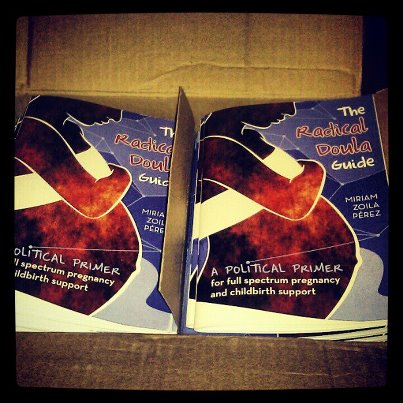
Online orders now available for The Radical Doula Guide

Photo of Radical Doula Guides in boxes

The online order system for copies of The Radical Doula Guide is now up and running! Thanks for all the interest and support, it’s been an AMAZING week.

Go here to place your order today.

If you want to order 10 or more copies, email me directly (radicaldoula@gmail.com) so I can give you a bulk discount.

Soy Poderosa!

Latina Week of Action logo

This year I once again have the pleasure of working with the National Latina Institute for Reproductive Health on their annual Latina Week of Action for Reproductive Justice.

They are an organization close to my heart–it’s the first place I worked when I graduated from college, and I’ve stuck around in one capacity or another ever since.

For this year’s Week of Action, the theme is Soy Poderosa (I am powerful). It’s about claiming power and space for the Latina community–about elevating the ways in which we are already working to shape our lives and our futures.

Why am I a Poderosa?

Because I believe in the power of my community. Because I know that even with few resources and little institutional power we are doing incredible things to secure our right to livelihood.

I’m powerful because I choose to have a voice, I choose to put my ideas and thoughts out into the world.

I’m powerful because I know that the arc of history bends toward justice, and that while my community has suffered greatly, we have also persevered, survived and even thrived.

Want to join the Week of Action? Check out these ways to get involved.

How doula skills translate

I just ran across this blog post from a doula-turned-lawyer, about how her skills as a birth doula have helped her be a better lawyer:

As a doula, I was required to listen more than I talked.  I learned to encourage women to ask questions and get information rather than doing it for her.  I learned that I couldn’t possibly understand all the circumstance of another woman’s life that drive her to make the decisions she does, but that I should do everything in my power to hear her and help her achieve those choices.  I learned to work behind the scenes, providing valuable skills and resources when needed, but never taking the spotlight away from those who really mattered: the woman, her family, and supporters.  Outside of the birthing room, I advocated for changes in a complex system of institutions, laws, and circumstances that make it difficult for women to have the birth they knew was best for them.

It’s great to see something that so reflects the way I think of my role as a doula, and to think more about how our skills as a doula can translate to other areas of life and work.

Because my doula work over the years has been infrequent (once a month at best), I often think about how what I’ve learned from being in this role influences everything else I do on a daily basis.

It definitely has, in big ways.

I like what she talks about in the post about not being the expert. So much of our society’s value is based on expertise–claiming it, selling it, being praised for it. As a writer, consultant and speaker so much of what I get paid to do is about the expertise I claim.

But I also think much of that expertise is actually really just intuition. Intuition about the world around me, about what makes sense in organizing, about observing and putting together bits and pieces into a coherent whole.

I think the biggest thing I’ve learned from my doula work has been to trust my intuition. That without much information, I can intuit what might be helpful to someone that I am supporting. That I’m not an expert in doula care, but that I’m following my gut and letting the person I’m working with show me what they need.