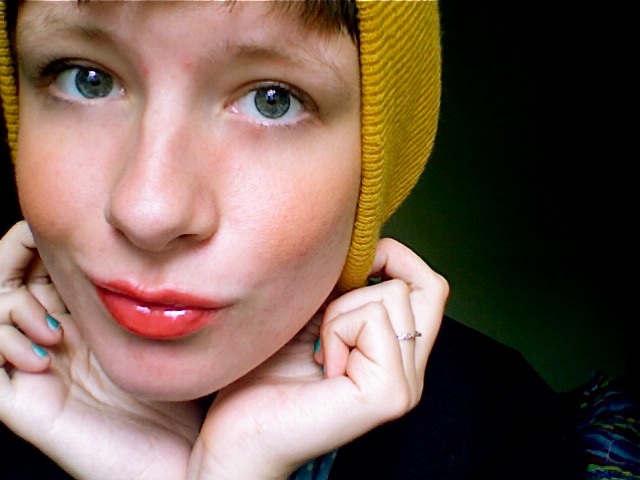
Bianca made this video blog about being an abortion with the NYC based Doula project. She’s awesome, and her experience very much mirrors mine. Also, her earrings rock.
Radical Doula Profiles: Karla Pippa
This is a series highlighting folks who identify as Radical Doulas. Are you interested in being part of the series? Email me.

Karla Pippa is an NYC based DONA intl trained doula. Previous to this, she spent the last 8 years working all over the country in the non profit world. As a campaign director, she empowered activists and organizers to find the inner strength and will to run intense environmental, human rights, and electoral campaigns. She brings her skills of coaching, motivation and understanding into her doula work and offers low-cost services to her community.
Contact Karla via email, doulapippa@gmail.com or at her website.
RD: What inspired you to become a doula?
KP: While I was running political campaigns across the country, I made sure to take time to attend both of my sister’s births. Watching (in awe), being with and supporting my sister during that challenging moment in her life reminded me of what it was like to work with an activist who just committed to turning out 100 people to vote in their neighborhood – overwhelmed, feeling moments of doubt but totally capable and powerful – they just needed to tap into that. What had always inspired me to do my political work was the ability to work with activists to push beyond their comfort zone and to be there to remind them that they are part of a community of people that want them to succeed and are ready to support them. I feel very much the same way about being a doula.
RD: Why do you identify with the term radical doula?
KP: When I tell people about my career transition most are surprised by what a “different path” I have chosen. But I dont see it that way. Much like in my work with organizers and activists, I look forward to bringing the same skills of motivation, coaching, advocacy, warmth and compassion to my doula work in order to help women feel supported and realize their inner strength in the birthing process. I want to be there when doubt and fear are confronted!
Why it’s time for us to reclaim “values”
I just got off the phone with a reporter working on an article about religion and spirituality in connection to home birth. Our conversation got me going, particularly when she told me of the Christian midwife who said that she doesn’t think pro-choice people should be doulas or midwives. That it’s a contradiction to work with birth and hold pro-choice beliefs. It makes my blood boil.
People often assume that radical politics go hand in hand with atheism, or a rejection of religious beliefs. The Religious Right in this country has furthered that idea by claiming the realm of religion, of God, of spirituality even, as their own. They promote the idea that being religious means certain things about your political beliefs and actions.
My doula work is about providing non-judgemental support to a person during pregnancy. Period. Just like I don’t bring my judgements about how the birth should happen, what tools should be used, or even how or when the pregnancy should happen, I don’t bring my judgements about the choices the pregnant person makes about their pregnancy.
I know that many of you who identify as radical doulas bring a sense of spirituality to your work, and I want us to claim that. I want us to reject the idea that radical politics (which, by the way, in an ideal world wouldn’t be so damn radical) are inherently atheist, or anti-religion, or anti-spiritual. Inherent in that rejection is that we get to claim, rightfully, that a belief in God or some sort of higher power doesn’t go hand in hand with anti-choice views. Anyone who studies the Bible, the Old Testament, knows that the beliefs that the Religious Right holds up as so clear, so self-evident, are not. It’s all about interpretation.
I want us to talk about values. I hold dearly the fact that my VALUES as a doula are based in the principle of non-judgmental support. My values are that I don’t know what is best for anyone but myself, and as a doula I serve folks during pregnancy by remembering that, always, and simply searching for the best way to validate and support someone’s experience.
I wholeheartedly reject the idea that family values are based in principles of hatred, discrimination, non-acceptance and judgement. Those are the anti-choice, anti-sex, anti-woman and anti-gay family values are being promoted in the US.
I’ve got my own version of family values—helping people build the families they want to create, however they define family, in the most loving and supportive environment possible. My family values include empowering every family member to make decisions about what’s best for them—whether those decisions are about how to dress, when and how to begin romantic relationships, how to be sexual, what to do when they are pregnant, what pronouns to use, damn even what food to eat every day. Again, I don’t know what’s best for anyone but myself. My values center on creating an environment where everyone can make the absolute best, educated and supported decisions about their lives.
Don’t get me wrong, I have a shit ton of opinions. I’m a blogger! But my opinions stop where your choices begin. I can express them from here til kingdom come, but YOU know what’s best for you. Period.
I’m sick of the left being painted as rational or logical but values-less. That’s complete and total bullshit. I’ve got an incredible set of values right here, and I think you do too. We just need to start talking about them.
Homebirth Ryan Gosling
If you’ve been following the tumblr meme of sites that use photos of Ryan Gosling with “Hey girl” sayings, it’s excitably reached the birth activist world.
Homebirth Ryan Gosling shows us all sorts of approving statements about homebirth from America’s heart throb. One part poking fun at the birth activist community and one part legitimate support for homebirth, it’s worth checking out.
Increase in home birth leaves women of color behind
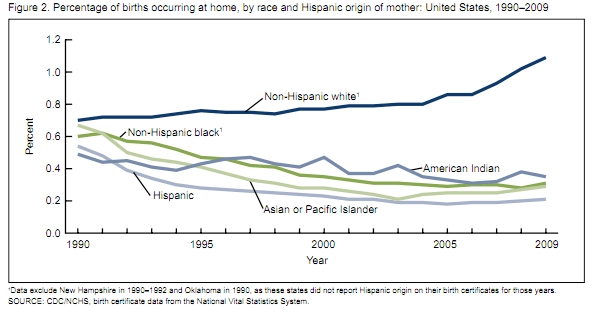
Last week, the CDC released data proving what those of us in the birth activist community have noticed for years: home birth is on the rise. They evaluated home birth numbers from 1990-2009.
After a decline from 1990 to 2004, the percentage of U.S. births that occurred at home increased by 29%, from 0.56% of births in 2004 to 0.72% in 2009.
There are many reasons for this increase, from Ricki Lake and the Business of Being Born, to studies that show serious problems with our maternal and fetal mortality rate. Also midwifery is on the rise, and CPMs have been successfully pushing for recognition at the state level.
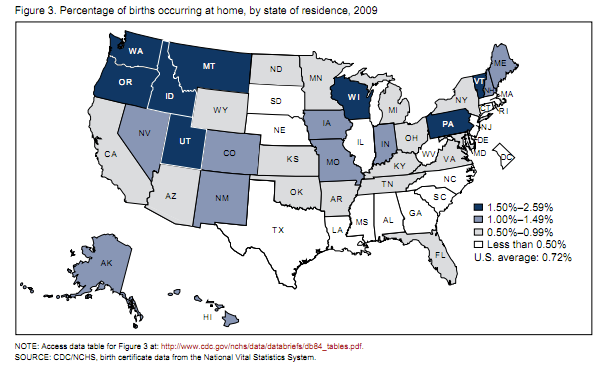
To those of us who support the midwifery model of care and believe that leaving the hospital setting is a good idea for many low-risk births, this is great news. It’s also still disappointing that the overall percentage is so low–less than 1% of all births! Although when you look at it on a state level, there are places (like Montana and Oregon) where the rates are double the national average.

But, as we’ve come to expect, when you examine these numbers based on race and ethnicity, the picture is very different:
For non-Hispanic white women, home births increased by 36%, from 0.80% in 2004 to 1.09% in 2009. About 1 in every 90 births for non-Hispanic white women is now a home birth. Home births are less common among women of other racial or ethnic groups.
About 90% of the total increase in home births from 2004 to 2009 was due to the increase among non-Hispanic white women.
The chart above shows just how dramatic the disparity is. I addressed some of my thoughts about what’s behind this gap in this post, which generated some good discussion in the comment thread.
I think we’ll see that racial gap diminish when midwifery advocates include people of color in their work. When more midwives and doulas of color are leading these initiatives, and also when public funding for out-of-hospital birth care is addressed.
The other disparity that the CDC study points out is a geographic one, which may also mirror the racial disparities:
The percentage of home births was generally higher in the northwestern and lower in the southeastern United States.
This Northern/Southern disparity is true for many health outcomes, and can probably be attributed to demographic differences, as well as a political climate that more favors midwifery and out of hospital birth in the Northwest. It’s clear we need more strong midwifery advocates in the South–and that would also be a place where it would make sense for people of color to take the helm.
We know that a shift as radical as bringing maternity back out of the hospital is going to take decades. It was a decades-long, well-funded campaign that brought birth into the purview of doctors and hospitals to begin with. The good news is we are moving in the right direction, but if we leave women of color behind, we’re not going to achieve the wide-spread culture shift we’re working towards.
42 volunteer doula programs and counting!
Every once in a while I do a significant update of the volunteer doula program page I’ve been maintaining on this site for a few years. Recently I added a few new full spectrum doula programs (yay!) and with the help of my friend Eleanor, made sure all of the links and such were working on the other programs listed.
We’re up to 42 programs in 15 states, the District of Columbia and two international programs. Pretty incredible.
That means there are likely thousands of you out there volunteering your time to support folks through pregnancy and childbirth. Amazing.
If you know of a volunteer program that is missing from my list, just send me an email with links or details and I’ll add it.
The list is not an endorsement of any of the programs, just a resource for people looking to volunteer their time.
So what is an abortion doula?
Obviously this is a topic much discussed on this blog, but it is also a role that is ever evolving. The Doula Project of NYC has had a major role is shaping this work, so I’d thought I’d share a recent interview published by Abortion Gang with Leadership Circle member Kathleen Reutter.
The Doula Project of New York City is a non-profit providing support to people across the spectrum of pregnancy. It is volunteer-run and all of its services are free of charge. Since 2008, its 50 trained abortion and birth doulas have provided services to over 5,000 people in the New York City area. I talked with Kathleen, who has been a doula with the Project since 2009 and a member of the Leadership Circle for the past year and a half.
To start-off, could you first describe a little about what an abortion doula is?
An abortion doula provides emotional, physical, and informational support to people choosing abortion. As part of the Doula Project, our doulas also support people facing miscarriage, stillbirth, and fetal anomaly and provide birth doula services to low-income people and to people choosing adoption. All in all, our mission is to offer care and compassion to pregnant people making a variety of choices regarding their pregnancy and/or birth.
What does a day’s work for an abortion doula look like?
Depending on the site, our doulas work with between four and 15 abortion clients per day. When I work with an abortion client, I try to help her feel safe and at ease. Any medical procedure can be scary, but facing an abortion can be especially frightening for some because of the wealth of inaccurate information and the stigma surrounding the procedure. Before the abortion begins I try to help my client feel comfortable by answering her questions and chatting. I’m usually with her as she meets the doctor and the nursing staff.
Being awake during an abortion is very doable but is sometimes painful. During the procedure I may help her breathe through uncomfortable moments, explain what’s happening, squeeze her hand, stroke her forehead, and distract her with conversation about her favorite TV show or her weekend plans. Afterwards I help her get settled in the recovery room. I may give her a hot pack to place on her abdomen to help with cramps and put cool cloths on her forehead and back of her neck if she’s overheated. Some of my clients want to talk a lot in the recovery room, others are quieter. If my client is settled and seems to be feeling okay, I often sit quietly in a chair close by, ready to engage if and when she chooses.
Read the full interview over at Abortion Gang. And for more about my experiences as an abortion doula, check out my Abortion Doula Diaries series.
Florida Senate unanimously passes anti-shackling bill
Via The National Advocates for Pregnant Women, news that a bill which would institute universal standards for Florida prisons, jails and detention facilities in regards to shackling of pregnant incarcerated women has passed the Florida Senate.
Writing for the Florida Independent, Ashley Lopez reports:
A bill that would create uniform and humane rules for the shackling of incarcerated pregnant women passed the state Senate unanimously today.
State Rep. Betty Reed, D-Tampa, and Sen. Arthenia Joyner, D-Tampa, introduced the bill this session to creates rules in county and city jails to protect the health of pregnant women who are incarcerated. Advocates for women’s health have said the law would fill a present gap in jail policies in Florida.
Joyner echoed the feeling expressed by advocates and said today that the bill would “address a deficit in Florida law” by adding rules that require “equal and uniform treatment” of women who are incarcerated.
Lopez told me via twitter that the next step is passage in the House. Great news for Florida, let’s hope it makes it all the way to law.
Update: The bill moved forward in the House today, through its first committee step.
Radical Doula Profiles: Sarah Hawkins
This is a series highlighting folks who identify as Radical Doulas. Are you interested in being part of the series? Email me.
Sarah Hawkins is a proud feminist and birth doula. She received her training through Natural Resources in San Francisco, California by a local midwife. She is familiar and deeply interested in meditation and homeopathy as resources for pain relief. Sarah has volunteered at hospitals as a birth doula and offers low-cost services to her community. Sarah’s website is www.homegrownheartsbirth.com.
What inspired you to become a doula?
I became inspired to become a doula when I realized how women are treated in the US’s medical care system. There are so many times when having a gynecological appointment that I wished another person was there to provide me strength, comfort and knowledge. I can now provide that for expected mothers in their most life-changing time.
Why do you identify with the term radical doula?
I identify with the term “radical doula” because I see every doula as doing something radical. Each and every doula is changing the approach to birthing by being present, passionate, and knowledgeable.
What is your doula philosophy and how does it fit into your broader political beliefs?
My doula philosophy is that every birth is spiritual and a celebration. No matter the plans that go astray or the special circumstances that arise, a baby is still coming into this world and that is the joyest of occasions.
What is your favorite thing about being a doula?
My favorite thing about being a doula (aside from just being apart of a beautiful birth!) is helping a person realize their inner strength and that they are capable of birthing.
If you could change one thing about birth, what would it be?
I would change the stigma that birth is a medical event. Birth is natural process that our bodies were built to handle and that it is “pain with a purpose”.
Abortion Doula Diaries: Advice for supporting a friend
There was a post on Jezebel last week that tackled the question of how to help a friend through an abortion. It was a follow-up to a similar post about helping a friend through a miscarriage. Both posts are worth checking out, as they give good advice to friends and support people.
The main takeaway from both, which happens to be my main tactic as an abortion doula, is listen and don’t assume.
Most of the time people looking for support really just want to be heard and to have their feelings validated. They don’t want to be told they should feel differently than they do, or even necessarily helped to cheer up. Think about it next time you are struggling–what do you really need?
Because pregnancy, and especially abortion, are such hot-button political issues, we’ve all got an opinion about it. We’ve all got the latest anti-abortion injustice on our minds.
People are often surprised when I tell them that my work as an abortion doula is mostly about listening, and hand-holding. Not a lot of talking, or educating, or even really doing. A lot of smiling, a lot of encouragement to breath and relax, and a whole lot of listening.
With friends and family members the temptation to give advice is really strong, because we know them and their life and might think that means we know what is best for them. But unless someone is asking us for advice, or asking questions, the best thing we can do is listen and validate how they are feeling. The reality is we don’t know what’s best for anyone other than ourselves.
This is something I’m working hard to apply to my everyday life, but it definitely applies in the context of abortion or miscarriage support.
The only correction I’ll provide to the Jezebel post is to this part:
Baumgardner notes that abortion doulas can offer support to women going through the procedure — you can help her figure out if a doula is right for her, or help her locate one.
While abortion doulas do obviously exist, I know of no programs where individual people can seek out and bring a doula along with them to a clinic. Most of the abortion doula programs partner with clinics directly, so if you went to one of those clinics, you’d most likely encounter a doula there who would accompany you.
What the article references is more like a birth doula situation. It’s possible that abortion doulas will shift to that model some day, but for now it’s primarily clinic partnerships. If there is an abortion doula group in your area (I have a list here, any programs with asterisks) you could get in touch with them to see what clinics they serve, and choose your provider that way.