Radical Doula Profiles: Michelle Craig

This is a series highlighting folks who identify as Radical Doulas. Are you interested in being part of the series? Go here to provide your responses to the profile questions and I’ll include you!

Michelle looking at camera with glasses on headAbout Michelle Craig: I am a married mom of 3 kids in Dallas, TX. I am a proud supporter of the lgbt community. I am also a supporter of a women’s right to choose what she does with her body. Contact: misha082581@gmail.com, on facebook, and on the web.

What inspired you to become a doula?

The empowerment of birth. How one can connect within themselves during childbirth. The emotional toll it takes on women.

Why do you identify with the term radical doula?

Pregnant family’s of all backgrounds straight, single, gay, trans, lower income, all deserve to have a support team. They deserve to have the right to information regarding procedures, the right to quality care, and they deserve the right to have unconditional love and support through their journey!

What is your doula philosophy and how does it fit into your broader political beliefs?

I believe that all people no matter what back gourd deserves the right to a informed, empowered, and supported birth. Because if you are connected to your birth then you have a better chance at being an amazing parent.

What is your favorite thing about being a doula?

I love being apart of something so spiritual and scared in someone’s life. Empowering them to believe in themselves.

If you could change one thing about birth, what would it be?

That everyone deserves the right to have a supported and loving team during labor. As well as a right to informed decisions.

Radical Doula Profiles: Jasmine Krapf

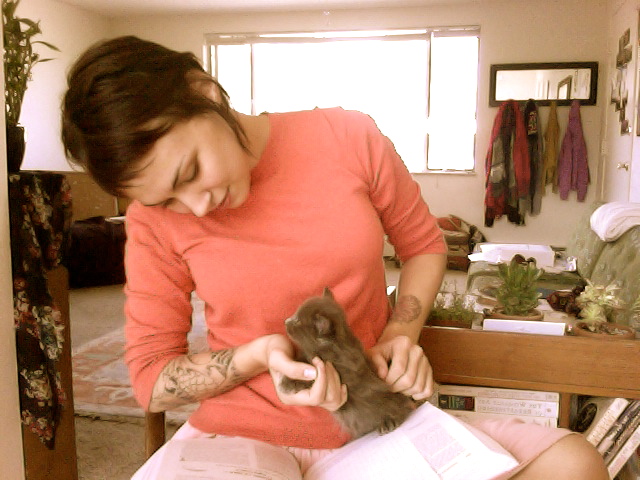
Jasmine in pink shirt holding small kitten

This is a series highlighting folks who identify as Radical Doulas. Are you interested in being part of the series? Go here to provide your responses to the profile questions and I’ll include you!

About Jasmine: Jasmine is a doula in Denver, Colorado. In her free time, she likes to dance, garden, and write for Mother Wild Zine-Blog. She works as a massage therapist and is studying midwifery, women’s studies, and herbalism. Jasmine is a member of Colorado Doulas Association (CDA), Colorado Midwives Association (CMA), and Midwives Alliance of North America (MANA). She is also a member of the low-cost doula program through the CDA working with low income families.

Find Jasmine: On the web, and on facebook.

What inspired you to become a doula?

A transformative and empowering birth experience is what inspired me to become a birthworker. I remember weeping weeks after the birth of my daughter remembering how sterile and eerily silent the labor & delivery unit was – I was the only woman moaning through contractions, the only woman to experience a natural birth in that hospital in a very long time (said the nurse). I felt heartbroken thinking of how sad the current system is. Birth is a biological process that is to be deeply respected. Women’s bodies and the mother-baby experience of birth can be so powerful when left alone to blossom in its own time, in its own way.

Why do you identify with the term radical doula?

I suppose I identify with the term “radical doula” because I’m somewhat radical in my approach to social activism, not only in the world of birth, but in human rights as well. Along with being a mom and a doula, I’m a massage therapist, student midwife, “placenta enthusiast,” amateur herbalist, and all-around birth geek. I’m also currently pursuing a degree in Women’s Studies because I feel birthworkers should know about all of women’s issues, and not just the realm of reproductive health. I run a blog and magazine and love to get involved in the street art scene (painting quotes about women’s empowerment and midwifery).

What is your doula philosophy and how does it fit into your broader political beliefs?

I personally believe childbirth has the power to transform women and families on some of the deepest levels. As care providers, we either assist or hinder that transformation by either respecting or disrespecting her autonomy. I’m a firm believer in informed choice and the “live and let live” philosophy, meaning every birth is as unique as the woman and baby experiencing it – and we should honor that by staying present, mindful, and aware of her special desires.

What is your favorite thing about being a doula?

I’ve attended both home and hospital births, both unmedicated and medicated, both physiological and induced births – and the one thing I’ve noticed they all have in common, no matter how a labor and birth unfolds, is that families come together with strength and grace and a beauty all their own. I believe in my heart that when we celebrate new life, when we connect, laugh, weep, and rejoice – we realize what it means to be human. After all, why hush ourselves? We’re alive.

If you could change one thing about birth, what would it be?

I would remove the fear of birth from women’s hearts and minds. I’d love to see a world where women looked at birth as a creative and intensely beautiful rite of passage.

Philadelphia Trans Health Conference 2013

This post should have happened months ago, so that all you lovely people who didn’t know about this conference yet would have gotten it together and made plans to make it there.

But, alas, that is not how my life goes.

So, better late than never! This year I’m once again presenting at the Philadelphia Trans Health Conference. There are a number of reasons I like this conference:

  1. It’s free!
  2. It’s really community-focused, meaning the panels are run by lots of different people, from many different professions and walks of life. It’s not just for those who are employed by non-profits that work on trans issues, although those folks are there and well represented also.
  3. A conference where thousands of people come together to talk about the needs of trans folks, and the majority of the attendees themselves identify somewhere on the trans* spectrum!
  4. Since I first attended four years ago, the presence of birth workers has steadily increased. So much so that last year we were able to have a panel specifically about birth work, with all trans and GNC identified birth workers speaking! Wowza, how things change.
  5. Did I mention it’s free?
  6. It’s next to one of my favorite indoor markets of all time: Reading Terminal Market, where you can get all sorts of super yummy food.

I’ll be part of two sessions this year, one similar to last year’s about birth work and trans/GNC folks, and another that is specifically for networking and community building among birth workers. I’ll also have limited copies of the Radical Doula Guide with me for sale, in case you haven’t picked one up but still want to (no shipping!).

Hope to see some of you there! And those who can’t attend, keep it mind for next year.

Review: What Makes a Baby

What Makes a Baby Book Trailer from Cory Silverberg on Vimeo.

A few months back I got a lovely email from Cory Silverberg telling me about a new book that he authored: What Makes a Baby. After a very delayed email exchange (I’ll admit I am often sloooowwww to respond) I received a copy of this lovely book in the mail.

The promises made in the trailer above definitely deliver. It’s an amazing specific yet unspecific story that helps tell the tale of where babies come from—all the modern and queer possibilities included. It does an incredible job of being inclusive of all genders and bodies. It also tells a birth story that includes the possibilities of a c-section and a vaginal birth, of midwives and doctors.

I’m not an expert on kids books, or what works when teaching kids about sensitive subjects like this one, but I’m happy to have this on my shelf for future use with family and friends.

The book is now available for purchase. A readers guide and more are available here.

Radical Doula Profiles: Louise Powers

This is a series highlighting folks who identify as Radical Doulas. Are you interested in being part of the series? Go here to provide your responses to the profile questions and I’ll include you!

Louise holding small newborn, smilingAbout Louise Powers: I am a Doula & Qi Healer. I have studied many religions and philosophies and I have a deep respect for the value of all faiths and cultures. Through marriage and adoption I have family on 4 continents, living in and coming from many different countries. I completed Birth and Postpartum Doula Training through DONA International and I am training through CAPPA as well this year. I continue to educate myself on the subject, of birth and child care.

What inspired you to become a doula?

I have been learning about birth and infant care since I was 13 and my mother was having my little brother. I became very involved in the process with my mother. We researched everything we could about pregnancy and newborns. I helped her as I have helped many new mothers for over 20 years now. It has become both a passion and a rewarding way to help others.

Why do you identify with the term radical doula?

I identify with the term radical doula because I believe in women making choices for themselves & that each woman deserves nonjudgmental support. Although this should not be a radical idea, every day I hear about more women who are judged for their choices.

What is your doula philosophy and how does it fit into your broader political beliefs?

My philosophy for birth is simple “YOUR birth. YOUR choice.” It aligns with my philosophy about everything else – “YOUR life. YOUR choice.”

I don’t want other people to judge me. Why would I judge you?

What is your favorite thing about being a doula?

Seeing women believe in themselves & connect with their own personal power.

If you could change one thing about birth, what would it be?

I would stop women from passing judgement on each other.

Radical Doula Profiles: Grace Dillon-Moore

Gracie with baby, smiling in black and white photo

This is a series highlighting folks who identify as Radical Doulas. Are you interested in being part of the series? Go here to provide your responses to the profile questions and I’ll include you!

Gracie Dillon-Moore, a radical doula in Knoxville, Tennessee has a double degree in women’s studies and psychology. Intrenched in the psychology of pregnancy and birth and motivated to assist women in the physiological, unmedicated birth they desire, Gracie became a childbirth researcher, educator, and certified doula. Gracie seeks change in the American woman’s birth experience. She believes education, support and resolve can carry a woman through the birth experience, naturally. Contact Gracie here.

What inspired you to become a doula?

My own birth experience inspired me to help other women who desire an unmedicated, natural, physiological birth. I believe this process of birth as nature intended is a springboard to the rest of the mother and family’s life together.

Why do you identify with the term radical doula?

I identify with the term radical doula because unlike most doulas and childbirth educators, I choose to work only with women who seek unmedicated births. It may seem exclusionary to some but I find my student’s needs for information and support on giving birth naturally are sugar-coated and often dumbed down by those trying to honor all types of birth (which of course is necessary, too). If you are seeking a natural, unmedicated birth, you must build resolve, confidence and awareness. Only through respect of your body and the labor process can a woman own and champion an unmedicated birth in the United States. Therefore, I support Radical Mamas, who seek Radical Birth. I am a Radical Doula.

What is your doula philosophy and how does it fit into your broader political beliefs?

My doula philosophy is that every woman deserves support in labor and birth. That support should come from her partner first and her doula second. The doula is the guardian of both mom and partner, meeting their gaze at each glance-offering steady reassurance and unwavering compassion.

What is your favorite thing about being a doula?

My favorite thing about being a doula and childbirth educator is the change I witness between mom and partner. During my 12 week course, the partner shifts from passive to active participant in the birth process. During birh, both mom and partner are overcome with the gravity of what they accomplished together. Each time I attend a student’s birth I witness a couple, transformed by th power of their unity; this moment is my favorite thing about being a doula.

If you could change one thing about birth, what would it be?

I would change the dismissive, condescending, threatening, intrusive, disrespectful, non-evidence based “care” women receive in the majority of medicalized pregnancy, labor and birth. I would restore respect in women’s care during pregnancy and birth, encouraging women to tune into their instincts and intuition.

Radical Doula Profiles: Angela Emery

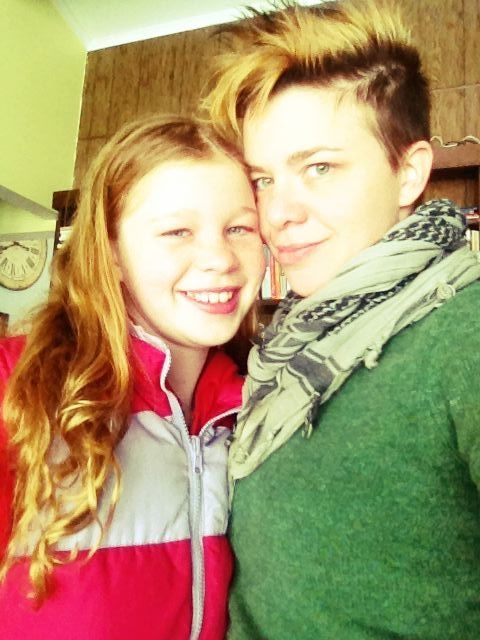
Angela wearing green sweater with a younger person wearing a red jacket

This is a series highlighting folks who identify as Radical Doulas. Are you interested in being part of the series? Go here to provide your responses to the profile questions and I’ll include you!

About Angela: I am just returning to the doula-world after a five year hiatus. In the birth have worked as a birth and postpartum doula, a childbirth educator, abortion counselor, and residential counselor at a home for pregnant and parenting teens. I have also as a homeless out reach worker, disability rights activist, mental health counselor, and girls-program coordinator at a feminist organization. My doula business is called RaDoula and is open to everyone and works on a sliding-scale. I offer doula services in abortion, pregnancy, birth, and postpartum. I am particularly interested in serving queer, teen, low-income, disabled, in immigrant populations. On a personal level, I am a queer, poet, activist, midwifery student, and mama to an 11-year old wonder girl. My dog only has 3 legs but can run faster than you.

What inspired you to become a doula?

I started studying midwifery shortly before I became pregnant with my daughter. A lot of midwifery courses suggest or require that you have doula training. Once I started working as a doula, I realized how important the role is in a birth. Additionally, I am very interested in politics, anthropology, and feminism- the three of those things combined along with a nurturing personality lent to me being a natural at this doula thing!

Why do you identify with the term radical doula?

I guess I’d have to take a Rebecca West stance on this when she said, “Feminism is the radical notion that women are people.” Radical comes from the Latin world for “root”. Being a radical doula, to me, means that I’m getting at the root of the feminist, the root of feminism, the root of biology… the root of a person and believing in them… and maybe helping them to grow.

What is your doula philosophy and how does it fit into your broader political beliefs?

As a doula the two most important aspects to my services are 1. Providing information to assist in decision making and 2. Offer support and advocacy, regarding the wishes of my client, regardless of my own opinions.

This philosophy fits into my very strong political pro-choice beliefs. These beliefs extend beyond choices before/during pregnancy, but also into birth, post postpartum and through out life. I believe that an individual body is that individuals body-period. With that said, I also believe that our society makes a lot of misinformed and uninformed decisions. The pregnancy, birth, and postpartum worlds are all ones with which I am very familiar. I am proud to offer that information to my clients and then support them, no matter what their decision. One of my favorite quotes is “If you don’t know your options than you don’t have any.” I stand by that.

What is your favorite thing about being a doula?

The connection and seeing women feel empowered and POWERFUL!

If you could change one thing about birth, what would it be?

Well, I don’t have a problem with BIRTH, per se, but the medical system that has taken over the birth process and changed it into a business pisses me off a bunch- I would change that for sure.

Doula Training Spotlight: Intuitive Childbirth

UPDATE February 19, 2014: Since I posted this almost two years ago, there has been a lot of back and forth about Intuitive Childbirth, questioning the program and the founders, including recent allegations of connections to white supremacy websites and comments. I am keeping this post here so that the comment record remains and people who search for this group can do their own research and see the record of different experiences with the program. I am not comfortable endorsing the organization at this point because of the various allegations–but I want this record to exist for future potential students so the allegations don’t disappear along with the post. I also removed the group from my list of doula training organizations.

I’ve kept on updating this list of doula training organizations, and it continues to grow! Most of the training groups I know little to nothing about, and the information has come from reader emails and the training websites. The list is not an endorsement of any particular training, just a resource for those looking for training options.

Occasionally though I’ll be posting guest posts about different trainings, just to give folks a little bit more info for those interested.

The info below came from an email from Samantha, one of the cofounders of Intuitive Childbirth, a new doula training that is FREE. Yup, you heard that right, free.

I have been working, along with another two doulas, for nearly three years now, developing a doula training course that is unlike any other program in existence, four specific concepts in mind:

1. Our training is free. Throughout my own journey as a doula I have encountered countless women who have the passion and desire to become a doula but lack the financial resources to do so. With the high fees the majority of programs charge, this inability to sacrifice financially is understandable, but I was outraged that women who felt so passionately and had such a great desire to make a difference in this realm were being denied the opportunity to do so.

2. We support choice. Nearly every other organization officially supports natural, unmedicated childbirth, interventions only when necessary. Although I am in full support of natural birth, I think it is important for doulas and women to recognize that this may not be the right choice for every woman and every birth. The only “wrong” decisions in birth are those made in ignorance, or against the mother’s desires. Every woman deserves the support of a doula, no matter what her desires for her birth are, and by officially supporting natural birth only, we are closing off a very large demographic of women to the incredible amount of support a doula can provide. We support choice. We believe that every woman intuitively knows what decisions are best for her. it is her doula’s job to help educate, inform, guide and support her as she discovers for herself what those decisions are.

3. We support the autonomy of a doula in her practice. Many organizations place restrictions on how a doula can and cannot practice. Some organizations forbid the use of essential oils or accupressure. Some forbid doulas from attending unassisted births. These restrictions are unfair to the doula as she should be able to practice as she sees fit. Again, it all comes down to choice. If the mother has made an informed decision on using essential oils in labor, I see no reason as to why her doula should be forbidden from assisting and supporting her in that choice. If a woman has chosen an unassisted birth, but desires a doula and is aware that a doula cannot act in the capacity of a midwife, I see no reason why she should be denied the presence and support of one.

4. We require our doulas to pay it forward. Our doulas are required to offer their services free of charge to a woman in need once per year in order to obtain and maintain their certification through Intuitive Childbirth. Just as we want to provide every woman who has the desire to become a doula the opportunity, we also want to help ensure that every woman who desires a doula at her birth has the opportunity to obtain one, regardless of financial limitations. It may only be one birth each year, from each doula, but for that woman that year, it can make a world of difference. And that is what we are all about. Changing the world, one doula at a time.

Interested in learning more? Check out their website.

A different kind of Mother’s Day celebration

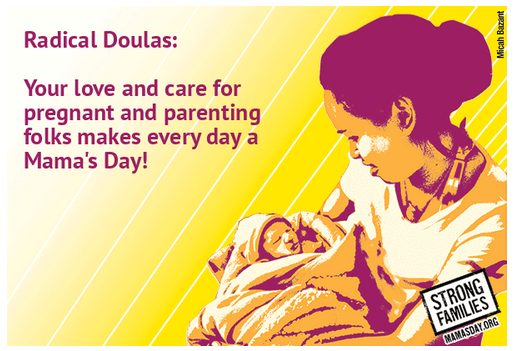
An image of a person holding a baby, with text that says "Radical Doulas: Your love and care for pregnant and parenting people makes every day a Mama's Day!
Make your own card at mamasday.org

The vast majority of my living comes from the work I do with non-profit organizations, the majority of whom are in the reproductive justice arena, helping them with their online and digital communications work. It’s a skillset I’ve developed over the years of running this blog, as well as my time working at Feministing, and the work with these groups. It’s often very invisible work because I’m behind the scenes, providing support to staff, helping to plan campaigns, crafting strategies for how to use social media and other platforms.

But right now is the culmination of one of my main projects so far this year, for a group I’ve worked with going on three years now. They are called Forward Together, and they:

Forward Together is a multi-racial organization that works with community leaders and organizations to transform culture and policy to catalyze social change. Our mission is to ensure that women, youth and families have the power and resources they need to reach their full potential.  By developing strong leaders, building networks across communities, and implementing innovative campaigns, we are making our mission a reality.

This is the third year I’ve worked with them on their annual Mama’s Day campaign. It’s a campaign that seeks to shift the narrative on motherhood, and specifically bring love and light to the mamas who are more often demonized by our political climate and our media than celebrated. These means mamas of color, immigrant mamas, queer mamas, young mamas, incarcerated mamas and more.

This is the second year we’ve tried to do this by creating an ecard tool, with fabulous art by activist artists, that people can use to send cards to the caregivers in their lives, but also to create strong messages to share anywhere online.

The cards are absolutely beautiful, and there is also a powerful blog series from all sorts of folks reflecting on motherhood and parenting. There are a few cards that look like doula cards, and that I’ve seen folks using to send love between doulas and parents. The above one is my shout out to all of you and the incredible work you do.

Go here to make your own card.

ACOG says labor should begin naturally—When will medical practice change?

In my latest column at RH Reality Check I talk about new guidelines issued by ACOG regarding scheduled c-sections. They were addressing the practice of scheduled c-sections that have been producing pre-term deliveries, with a particular push-back on the  reasoning of a baby being too large to be born vaginally.

For those of us who’ve been tuned into the maternity care debate, these kinds of change of practice or philosophy from a group like ACOG seem like a huge turn around. So huge, that at first I thought the whole thing was a hoax.

But, thankfully, it’s not. ACOG is actually urging providers to “let nature take it’s course.” Similarly, they just released new findings regarding the impact (potentially negative) of pitocin use on newborns.

For those of use who’ve been pushing back against rising c-section rates and pitocin use for a long time, this is a victory. But the challenge remains that history tells us it will likely take a long time for these recommendations to actually influence medical practice. In my column I use the example of episiotomy to illustrate this lag:

Unfortunately, it could take years for these changes to go into effect. Just look at the history of episiotomies. In the 1950s and ’60s, episiotomies, a cut in the perineum (the region between the anus and vagina), were recommended as routine practice during labor. At the time it was believed that an episiotomy was preferable to the natural tearing that is very common during vaginal delivery, and that the straight incision of an episiotomy was easier to repair. A 2012 Huffington Post article outlines this history, and how the practice came to dominate by the 1980s, occurring in more than 60 percent of deliveries.

It was only then that clinical trials were conducted to examine the impacts of episiotomy in comparison to natural tearing, and the results were staggering:

Clinical trials conducted in the ’80s and ’90s found that episiotomy cuts can, in fact, turn into even deeper lacerations during delivery, damaging the area around the rectum. Then, in 2005, a sweeping review published in the Journal of the American Medical Association found no benefits to routine episiotomy. A year later, the American Congress of Obstetricians and Gynecologists issued new guidelines, saying that episiotomy during labor should be restricted because doctors had previously underestimated the risk of bad outcomes later on, such as painful sex and possible incontinence.

Decades after those clinical trials, and seven years after the new ACOG recommendations, it’s unclear exactly how the new recommendations regarding episiotomy are being implemented. In 2005, the year before the ACOG recommendations, a study in the Journal of the American Medical Association (referenced in the Huffington Post article) estimated that 25 to 30 percent of vaginal deliveries still involved episiotomy. The 2010 National Hospital Discharge Survey reported that roughly 320,000 episiotomies were performed in the United States that year.

So this is both good news, and a call to action for all of us. As consumers, advocates and doulas our efforts have contributed to these recommendations, and we must remain vigilant to ensure that they get implemented. We can share these recommendations, coming from the Association tasked with governing Obstetricians, with providers who may be reluctant. And we can keep the pressure on. It’s a long battle, but I’m heartened by these incremental signs of progress.

Read the full column here.