When Survivors Give Birth: A workshop with Penny Simkin

Cover of "When Survivors Give Birth" image of two hands holding a heart with a break line down the middleI wanted to highlight an upcoming workshop on the topic of working with survivors of violence and abuse in birthing situations.

It’s the weekend of February 5-6 in Seattle at the Simkin Center.

I think it’s an important topic for birth activists, as so many folks have experienced abuse and trauma in their lives that can be triggered in the birth process.

Penny Simkin is a well-known and widely-respected birth educator and co-author of the book When Survivors Give Birth. I haven’t read it myself, but I’ve heard good things.

More information about the training here, or you can check out the book here.

A happy birth story for the new year

I thought we’d start off 2010 on a good note.

Via Pushed Birth and CNN, the happy news that Joy Szabo gave birth vaginally to her fourth child on December 5th without incident.

Unfortunately she had to do quite a bit of fighting to have the birth she wanted. From Jennifer Block:

Joy Szabo of Page, Arizona, was told by her local hospital that she wouldn’t be allowed to give birth vaginally there. She even met with the hospital CEO to discuss their policy of forcing repeat C-sections — a policy she equated with physical assault — and the hospital responded by threatening to get a court order for the surgery. When the local paper headlined Szabo’s plight, the hospital backed off, but it still told her “No VBAC.” Instead of agreeing to the major surgery, Szabo pushed back. She found a willing hospital and provider in Phoenix, a six hour journey by car from her home, and made the decision to move there and await labor.

The birth was an easy one, with just a few hours of labor and one quick push. Congrats Joy!

Grit.tv takes on birth politics

There is a great segment on Grit.tv about childbirth in the US, featuring Debra Pascali-Bonaro (my doula trainer!) of the Orgasmic Birth documentary.

“The Bellevue Hospital Natural Birth center in Manhattan, one of the few centers that cater not to the wealthy but to poor women, closed this month amid controversy. With the ongoing debate about health care reform and costs, decisions about childbirth are getting lost in the shuffle. We discuss the closing of the birth center and the medicalization of childbirth with Katherine Abelson, midwife at the Brooklyn Birthing Center, Elan McAllister, doula and president and founder of Choices in Childbirth, and Debra Pascali-Bonaro, doula and director and producer of Orgasmic Birth.”

Full video after the jump!

Continue reading

Bellevue shuts down birth center for low-income women

Word got out a few weeks ago that Bellevue, a hospital in Manhattan (New York City) was shutting down their in-hospital birth center which was opened in 1998. It was the only birth center in Manhattan to accept Medicaid, and probably one of the few around the country serving low-income women.

From the NY Times:

The center gave healthy women the opportunity to give birth in a comfortable environment absent the frenetic bustle of a normal hospital delivery ward. Roughly 85 percent of the patients were Chinese- or Spanish-speaking immigrants, most of them referred though Gouverneur Healthcare Services on the Lower East Side. (All midwives were required to be fluent in either Mandarin or Spanish.)

The center allowed healthy expecting mothers to walk around, bathe in a Jacuzzi as a way to reduce pain naturally, and choose to forgo common but invasive medical techniques like induced labor and epidural blocks. Unlike women who chose natural birth at home, patients had immediate access to hospital facilities if there were complications.

Fans of the birth center said that it had a Caesarean rate of less than 4 percent over its lifetime; the hospital said that such a statistic was not available.

According to the NY Times, the closing was done secretively and without much notice to the public or even the hospital advisory board. While economics was cited as the reason for the closure, this flies in the face of the information about how the birth center reduced interventions (and cost) for women who delivered there.

I think this is just further proof that most hospitals don’t care that much about outcomes or patient satisfaction–they care about money. Rumor is that the birth center will be leased out for some other purpose (generating revenue via rent or the income of whatever facility they install).

Here’s the financial math that I think is insidious and behind this kind of decision:

While you would think it’s a good thing that these patients were having births that were much less expensive (because of lower interventions and c-sections), it actually means the hospital loses revenue. Why? Because they don’t have as much to bill Medicaid for, meaning less money for the hospital.

What does that mean? Our current system of health care (which is primarily profit driven) doesn’t result in the best care for women, or their children. It’s the same logic that has created our health care system which spends way more per capita than any other country in the world, but has relatively bad outcomes.

In 2002, the United States spent $5,267 per capita on health care—53 percent more than Switzerland, the next-highest-spending country, and 140 percent more than the median OECD country.

Want to try and get the Bellevue Birth Center back? Sign this petition by Choices in Childbirth.

Oprah.com article on alternative birth practices

I was interviewed for this Oprah.com article about alternative birth practices. It’s a pretty good overview of the standard aspects of alternative birth practices: midwives, doulas, out of hospital births, techniques like water. I seem to be the only source the author quotes, so here is a round-up of my contributions. While I’m flattered to be used as a resources I wish he had also talked to some other experts on the issue!

Also of note is that what seems to have drawn the author to the subject was his wife’s own delivery with a midwife in a birth center wing of a hospital just three months ago. He told me this during the interview, it wasn’t in the actual article. It’s so often that awareness about childbirth only comes when a person or their partner go through it themselves.

Read the whole piece here and see my quotes after the jump.

Continue reading

New children’s book about homebirth

I got an email from Kelly Mochel, the author of this new children’s book called “We’re Having a Homebirth!!”

She says she decided to create the book when they were planning for their homebirth and couldn’t find any literature for their 2 year old to read about the process. She self-published the book, which is available for purchase on her website.

I only saw the sample pages here, but I appreciate the frankness with which she talks about the issues at hand. For an example see this page about breastfeeding after the jump.


Continue reading

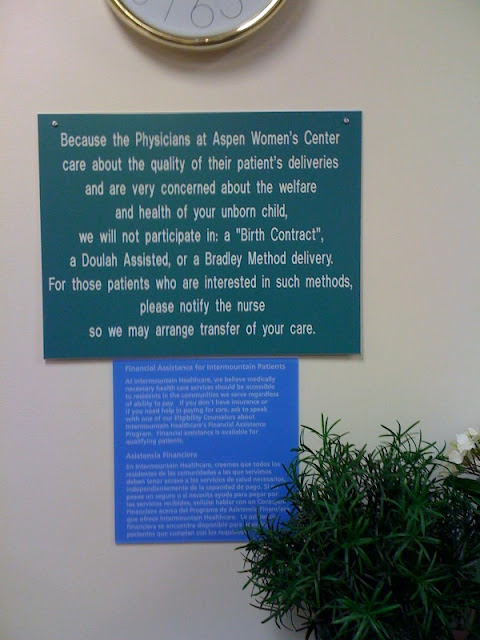
Signs you don’t want to see at your ob-gyn’s office

“Because the Physicians at Aspen Women’s Center care about the quality of their patient’s deliveries and are very concerned about the welfare and health of your unborn child, we will not participate in a “Birth Contract”, a Doulah Assisted, or a Bradley Method delivery. For those patients who are interested in such methods, please notify the nurse so we many arrange transfer of your care.”

Translation: We don’t care at all what you want as a parent, or a person in labor. We want a patient who will sit quiet and do what we say–no matter what. Oh and if you have a partner you want involved, tough. Your desires don’t matter.

Oh, and we don’t even care enough about doula’s to bother spelling the word correctly.

They should change the name of the center to the “Unborn Children Center” since they don’t seem to care too much about the women involved.

I hope this keeps plenty of women away from this clinic. Ridiculous.

Via The Birth Whisperer

More victories for pregnant incarcerated women

Yesterday, a victory from the folks at the National Advocates for Pregnant Women.

This case is pretty horrific. You can see more about Nelson’s story in the RH Reality Check video above. More info:

On Friday, the United States Court of Appeals for the Eight Circuit (the federal level appellate court that reviews decisions from federal district courts in North Dakota, South Dakota, Iowa, Nebraska, Missouri, Minnesota, and Arkansas) issued the long-awaited decision in Nelson v. Norris. In this case, Shawanna Nelson argued that being forced to go through the final stages of labor with both legs shackled to her hospital bed was cruel and unusual punishment, in violation of the 8th Amendment to the Constitution. She argued that she should be allowed to sue the director of the prison and the guard who repeatedly re-shackled her legs to the bed. Ms. Nelson, an African-American woman, was incarcerated for non-violent offenses of credit card fraud and “hot checks.”

The idea of shackling any person during labor is abominable, but in this case the one argument for the practice is bunk. The only argument I can think of (which I definitely don’t agree with) is that an incarcerated person could be “dangerous” and therefore need to be restrained, even while giving birth. It’s ludicrous for even the most “violent” of criminals, let alone a woman like Nelson, who was incarcerated for CREDIT CARD FRAUD. Absurd.

Continue reading

Giving women what they want in Peru

The New York Times last week had an article about a clinic in rural Peru that was able to draw more women in by using traditional childbirth practices.

When the women were asked why they didn’t want to give birth at the local clinic, they explained what all of us birth activists know well: they didn’t want to give birth alone, on a table, with providers who didn’t speak their language.

They started by asking people in the community about traditional ways of giving birth, and about what the clinic was doing wrong. They got an earful. Workers at the clinic did not speak the local language, Quechua. They treated patients brusquely, and barred husbands and other relatives from the delivery room. They forced women to wear hospital gowns instead of their own clothes, and made them give birth lying on a table instead of squatting. They threw away the placenta instead of giving it to the family to bury in a warm place.

We know these things. The women is this community were lucky, because the providers had to change their habits to meet their desires–because the women just weren’t coming to their clinic.

Working with local people, members of a nongovernmental group, Health Unlimited, changed delivery services at a clinic in the Santillana district. They made sure Quechua was spoken, let relatives stay and help, set up delivery rooms so that women could squat and made other changes based on local traditions.

By 2007, 83 percent of births were taking place at the clinic. In a report in this month’s Bulletin of the World Health Organization, the authors say that the project in Ayacucho shows that indigenous women with little formal education want professional help giving birth, and will use it if they are treated with respect at clinics.

Why are we building clinics and funding initiatives that have women’s desires and needs as an afterthought? Maybe stories like these will start to change the paradigm, cause the current model really sucks.

h/t to Maria Elena for the link

ACOG is making me nauseous.

Ugh. That’s how I feel everytime I get another press release from the Big Push for Midwives, or see another blog post from a doula or midwifery blog about what ACOG–the American College of Obstetrics and Gynecology is up to. Just ugh. The latest: a totally biased segment on the Today show. To be honest, I couldn’t bring myself to watch it. If you want to see for yourself, it’s here.

Oh, and then there was the internet campaign to get  stories about the “problem” of desire for out of hospital births. And before that was when they announced they would “allow” women in labor to drink modest amounts of clear liquids, but no food.

They’ve already GOT A MONOPOLY on birth in the US. 99 freaking percent of women are giving birth in the hospitals they control. That’s not enough apparently, because they are afraid. They are scared of all of us, of all the folks out there who are catching on about a different way to be, about how they can escape the hospital and reclaim some autonomy. They’re afraid of the 1% of women who have caught on, who give birth outside the hospital and away from their surgeons.

Still, because they are scared and they are more worried about the professional interests of doctors than the desires of their patients, they continue with their smear campaigns. The one thing that gives me comfort is that their fear is an indicator of our power. So let’s use it folks. People are catching on, and that is real.

The one positive thing that ACOG did recently was admit that their practices–which they say are fueled by fear of being sued–“ultimately hurt patients.” I would say that’s not the whole story, ACOG, but I will give you that our litigious society (and crappy doctor/patient relationship with little trust) makes things worse. Jill at Unnecesarean has more on this, but I would just add that midwives are also suffering from this litigious society and the fear of being sued. Often it’s not even the parents they care for who sue them–but local doctors who disagree with their practices. You can read about one of these midwives in my piece in The American Prospect. Again, she took this one doctor’s fear of her and turned it into action–helping to pass legislation in April to legalize the practice of CPMs there.