Radical Doula Profiles: Eliza Cooley

This is a series highlighting folks who identify as Radical Doulas. Are you interested in being part of the series? Go here to provide your responses to the profile questions and I’ll include you!
elizaEliza has provided doula services in the Dominican Republic, Colorado, and Nepal. Her experience as an international doula has inspired her to seek further training. In becoming a Certified Nurse Midwife, she hopes to train birth attendants in underdeveloped areas to provide safer pregnancy care and to reduce the astounding rates of maternal and infant mortality. Despite seeking further education, she plans to continue providing accessible doula care as part of her practice, as being with women during labor is her passion. Eliza is now based out of Massachusetts and travels frequently.

Website: elizathedoula.weebly.com
Email: eliza.the.doula@gmail.com

What inspired you to become a doula?
I became a doula by chance. I hadn’t heard the term “doula” when I was required to take a training before doing a medical internship in the Dominican Republic. After taking the workshop and attending my first birth, it was clear to me that birth work was my calling. I sought additional training and accepted a year-long position as a prenatal educator and doula for immigrant, refugee, and low-income populations in Denver, Colorado. Currently, I am providing support at births at a rural hospital in Nepal.

Why do you identify with the term radical doula?
I once asked someone about the high rates of maternal and fetal mortalities in underdeveloped countries and was given a simple answer: it’s just how it is. Sure, it’s how it is, but it is not how it has to be. Birth care and outcomes are far from equal in our world. As a radical doula, my work focuses on making high quality care more accessible and questioning the standards of birth care as they exist in communities across the globe. Acknowledging an unacceptable condition and committing to changing it – that’s radicalism.

What is your doula philosophy and how does it fit into your broader political beliefs?
A doula’s primary goal should be to provide continuous compassionate and nonjudgmental support and to reduce fear of labor and childbirth. Part of providing care should be empowering people to make their own decisions by providing accurate information. As a doula, I offer empathetic support and unbiased guidance but overall, I encourage women to use their knowledge, trust their bodies, and take control.

What is your favorite thing about being a doula?
When I first enter a room, figuring out how to manage the energy in the room by intuiting the laboring woman’s needs is exciting. It feels like an art form. I have also had women tell me that I reduced their perceived pain during labor – and that feels like a superpower!

If you could change one thing about the experience of pregnancy and birth, what would it be?
There needs to be a more sensitive application of Western medicine to pregnancy care. I have seen Western medicine save lives, but I have also seen it lead to major complications. I’d like to see a balance where providers hone skills in both natural techniques and the appropriate use of medical intervention. This balance, I believe, is the modern art of birth work.
A moment for White doulas to put allyship into practice and support doulas of color

Ever since I joined the doula movement there has been a strong anecdotal sense that the doula community is very white. While I haven’t seen any official data on this (I could imagine it’d be difficult to access a community that is pretty small, but also not congregated in any one organization), it’s the sense I’ve gotten from all of my time and work in this field.

In recent years there has been more attention to race and racism in the doula community, and way more doulas (and midwives, other birth activists) of color speaking up about race and representation.

I think there are many ways the doula community needs to engage with the reality of racism, how it impacts the maternal health of women of color, especially Black women, but increasing the number of doulas of color in our movement is one really important step.

I often get asked by white doulas–what can I do about racism and maternal health disparities? I talked a lot about this question in my speech from SQUATfest two years ago, but I didn’t explicitly answer it.

Well, now you have a major opportunity to step up. A group in the Bay Area is fundraising to bring more doulas of color (and low-income doulas, and formerly incarcerated doulas) into the work.

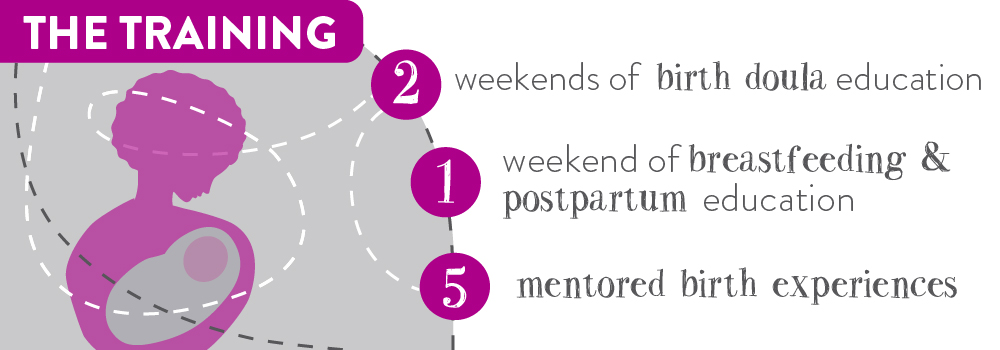
Infographic reads: "The training: 2 weekends of birth doula education, 1 weekend of breastfeeding and postpartum education, 5 mentored birth experiences."

Infographic that reads: "Your money goes to training 16 doulas of color, providing doulas to 80 families in the community that would not otherwise be able to receive doula support."
Infographic via East Bay Community Birth Support Project

Put your money where your mouth is. If we’re really going to change the culture of birth in the US, we’re going to need way more doulas who look like the women who are facing the most extreme challenges.

The fundraiser ends on Friday–now is your time.

Radical Doula Profiles: Erich Otten

This is a series highlighting folks who identify as Radical Doulas. Are you interested in being part of the series? Go here to provide your responses to the profile questions and I’ll include you!

erichotten

Erich Otten aka ‘The Doula Dude’ is a full-spectrum doula, anarchist birthkeeper and complementary therapist. He has supported women and reproductive people in various roles since 2008. Becoming a birth worker was naturally the next step, he services the St.Thomas – London, Ontario area. Offering scaled to income labour & breastfeeding support, birth counselling and pregnancy options counselling. As a doula he provides support and comprehensive care throughout the full spectrum of pregnancy outcomes. His practice name is Options Doula Care and he can be reach via his website or by e-mailing birthkeeper.erich@gmail.com.

What inspired you to become a doula?
I have been supporting women and reproductive people since 2008. My interest in supporting women throughout the childbearing year led me to originally pursue midwifery as a career and calling. I attended the 2013 Birth and Beyond Conference in London, Ontario on an attendee scholarship. There I met many amazing women and yes, doulas. At the ‘An Evening with Ina May’ event I was fortunate enough to be able to ask her one question. I asked. “What is your advice for aspiring midwives?” she replied. “Become a Doula.” So I followed her advice and fell in love with the care and role of a ‘doula’.

Why do you identify with the term radical doula?
Why do I identify as a ‘radical doula’? Well like the radical feminists before me reproductive rights have been at the forefront of advocacy. As a male embodied birth worker and intactivist, reproductive rights are at the forefront of my advocacy and beliefs.

What is your doula philosophy and how does it fit into your broader political beliefs?
As a full-spectrum doula, I’ll advocate for whatever birth outcome the reproductive person chooses. A cesarean section, elective termination, homebirth, or an hospital birth with an epidural. Whether they choose parenting or adoption. I’ll be there to support them. I have a particular calling to serve marginalized populations such as LGBTQ1+, young mothers, immigrant women, survivors of abuse, and incarcerated folk. I offer my services on a sliding scale. One of my core beliefs is to have access to a doula no matter what one’s financial status.

What is your favorite thing about being a doula?
My favourite thing about being a doula is bearing witness. Being permitted to share and hold that space. Birth, all out comes. Not just what we frame as birth that is the live birth of babes. Is elemental, I find it the basic stuff of life. And it is such an honour to be invited to walk into that space.

If you could change one thing about the experience of pregnancy and birth, what would it be?
I would change birth shaming and care-provider competition. I find no place for either in birthing and reproductive spaces.

To the 13 year old interested in becoming a doula

I get many, many questions via email from people interested in doula work, interested in writing about doulas, looking for a doula, etc, etc. I try really hard to respond to everyone, but it often takes me months (such is the state of volunteer labor-of-love work). But sometimes I’m inspired to share an email and response with you all, in case others might find it interesting. This exchange was just really sweet, because I love the idea of a 13 year old who already know about doulas, and has such insightful questions about what the career path would be like.

__________

Hi,
I’m 13 (name removed for privacy), and I’m thirteen years old. I have always found the prospect of helping people give birth amazing and I was wondering, what is it like assisting a person give birth? Is it stressful? Do you and your “patients” stay in touch after the birth? Do you have a job other than being a Doula? Do you have to already know the midwife, is it easier if you do? If you don’t know the midwife, do you become as close as you do with the patients (I don’t know what else to call them)? Thank you.
Sincerely, 13

Hi 13–

Thanks for your email! You sound like you’re already well on your way. It’s hard to describe what it’s like to be a doula. Yes, it can be stressful. Yes, it can be amazing. Sometimes you stay in touch, sometimes you’re just there for the birth and that is it.

I have always had jobs outside of being a doula–my doula work has been a volunteer thing. But there are people who live off of their work as doulas (although I will say it can be challenging financially–usually people supplement with other doula-related work).

Knowing the midwife definitely can make things easier, but no it’s not required. How close you become with the people you support (some people might call them clients) depends on you and them and how the relationship evolves–it’s not dependent on you knowing the provider.

Best of luck!