Last week, the CDC released data proving what those of us in the birth activist community have noticed for years: home birth is on the rise. They evaluated home birth numbers from 1990-2009.
After a decline from 1990 to 2004, the percentage of U.S. births that occurred at home increased by 29%, from 0.56% of births in 2004 to 0.72% in 2009.
There are many reasons for this increase, from Ricki Lake and the Business of Being Born, to studies that show serious problems with our maternal and fetal mortality rate. Also midwifery is on the rise, and CPMs have been successfully pushing for recognition at the state level.
To those of us who support the midwifery model of care and believe that leaving the hospital setting is a good idea for many low-risk births, this is great news. It’s also still disappointing that the overall percentage is so low–less than 1% of all births! Although when you look at it on a state level, there are places (like Montana and Oregon) where the rates are double the national average.
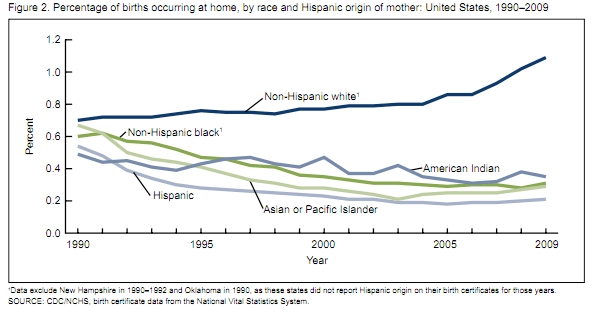
But, as we’ve come to expect, when you examine these numbers based on race and ethnicity, the picture is very different:
For non-Hispanic white women, home births increased by 36%, from 0.80% in 2004 to 1.09% in 2009. About 1 in every 90 births for non-Hispanic white women is now a home birth. Home births are less common among women of other racial or ethnic groups.
About 90% of the total increase in home births from 2004 to 2009 was due to the increase among non-Hispanic white women.
The chart above shows just how dramatic the disparity is. I addressed some of my thoughts about what’s behind this gap in this post, which generated some good discussion in the comment thread.
I think we’ll see that racial gap diminish when midwifery advocates include people of color in their work. When more midwives and doulas of color are leading these initiatives, and also when public funding for out-of-hospital birth care is addressed.
The other disparity that the CDC study points out is a geographic one, which may also mirror the racial disparities:
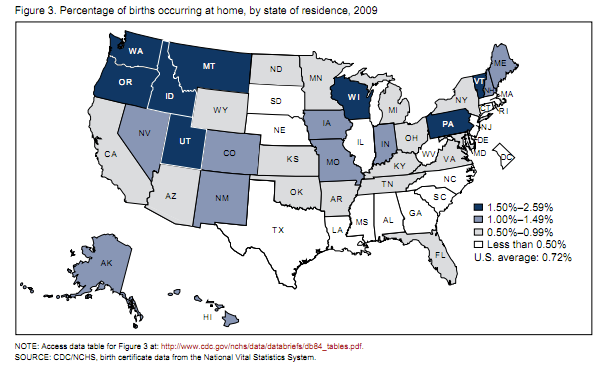
The percentage of home births was generally higher in the northwestern and lower in the southeastern United States.
This Northern/Southern disparity is true for many health outcomes, and can probably be attributed to demographic differences, as well as a political climate that more favors midwifery and out of hospital birth in the Northwest. It’s clear we need more strong midwifery advocates in the South–and that would also be a place where it would make sense for people of color to take the helm.
We know that a shift as radical as bringing maternity back out of the hospital is going to take decades. It was a decades-long, well-funded campaign that brought birth into the purview of doctors and hospitals to begin with. The good news is we are moving in the right direction, but if we leave women of color behind, we’re not going to achieve the wide-spread culture shift we’re working towards.

 Radical Doula